What Is Gemini 4 Argon? Access, Uses and Limits
Gemini 4 Argon is Google’s new frontier model. See who can access it, announced API prices, the output limit and a practical way to assess its work.
Gemini 4 Argon is Google’s new frontier AI model, announced on 30 September 2026. As of 1 October, its initial rollout is to selected trusted cyber defenders, while broader access is still upcoming. Google names paid API customers and Google AI Ultra subscribers as the starting point for that wider release. An announcement does not mean every Gemini account can select it today.
This guide uses public Google documentation checked on 1 October 2026. It explains what Argon is, how to read its announced costs and limits, and what to prepare before trying it. The separate Gemini 4 Argon safety guide covers the safeguards and data questions in more depth. No hands-on performance result is claimed here.
A model, an app and an agent are different choices
Google’s Gemini model page presents Argon as a model for demanding reasoning and multi-step work. It highlights software engineering, enterprise knowledge work, visual understanding and defensive cybersecurity. These are capability descriptions. They do not tell you which accounts a particular app can connect, which files it can open, or which actions it may take.
Think about the job you want done. A model can help interpret a document or propose a code change. A product around it determines how documents arrive, how tools run and where the result goes. The distinction in AI agent vs LLM matters because a stronger model alone does not create a complete workflow.
If you came here from OpenAI dots, keep the comparison at the right level: dots is an agent product, while Argon is a model. Likewise, Muse Spark and the Muse app answer different questions about Meta’s system. You can compare reasoning tasks between models, but account connections and ongoing responsibilities belong to the product comparison.
Who can use Gemini 4 Argon now?
Google’s launch announcement describes a phased release and does not give a calendar date for broader availability. Do not buy an Ultra subscription solely on the assumption that Argon is already included in your account. Check the current product notice and the model actually offered before making that decision.
The Fairwind Program explains the initial defensive access. It prioritises vetted organisations such as governments, critical infrastructure operators and core technology platforms. Access is controlled, and partners cannot redistribute it. Its application process is for eligible organisations; it is not a general consumer waitlist or a guaranteed invitation.
- For personal use, look for a current Google notice confirming Argon access in the product and account you use.
- For API work, confirm an officially documented model identifier, endpoint, billing terms and limits before changing production code.
- For an organisational trial, confirm who owns the project, which sources may be shared and who will review the result.
- If access is absent, prepare a small evaluation brief with your existing tool and keep the model name out of any claims about the results.
Announced API prices are not a subscription price
Google’s announced API pricing is an introductory US$2 per million input tokens and US$10 per million output tokens. The footnote states US$4 and US$20 respectively after the introductory period. Cached input is announced at a 95% discount to the input-token price. The announcement does not specify when the introductory period ends.
These are token rates, not a monthly Gemini app fee or the total cost of an agent assignment. Before estimating a budget, check which tokens your actual integration bills, whether repeated work uses caching and what separate tools cost. A long draft that needs redoing is still work you paid to generate. Track usable output as well as usage.
The large announced limit is an output limit
Google’s launch description of the limit specifies up to one million output tokens, increased from the previous 64,000. That is an output limit, not a statement that every app accepts a million-token upload. Input context, file handling and output settings are separate limits to check in the interface or API documentation you actually use.
For everyday work, more room to generate is useful only if the result stays checkable. Ask for a short decision brief before a long report. Keep the supporting evidence alongside the claims, and request extra detail where it changes a decision. A larger ceiling gives you headroom; it does not require you to fill it.
Read the benchmarks with their settings attached
The official performance table shows Argon ahead on some tasks and behind on others. For example, Google lists Argon at 77.9% on DeepSWE v1.1 but 55.0% on FrontierSWE v2, below GPT-6 Astra’s listed 65.5% on that second benchmark. Both concern coding; they do not support a claim that one model wins every coding job.
Google’s evaluation methodology says Argon results generally use the Gemini API at the highest thinking settings, with exceptions described individually. Competitor figures generally come from provider-reported results unless otherwise stated. The report also identifies harnesses and task-specific conditions. This is evidence about particular evaluations, not a measured result for your team’s documents.
Use those results to decide what to investigate. If you maintain software, build a trial around a familiar issue and an existing test suite. If you prepare reports, use source material whose important facts you can check. A public benchmark helps form a question; your own review establishes whether the answer is useful for your work.
A practical first trial: a supplier decision brief
Suppose your team needs a supplier for a workshop. You have public service pages, a fictional brief and sample quotes. The useful deliverable is a comparison that preserves requirements and makes missing information visible. You can prepare this trial now, then run it when official access reaches you. It is an evaluation plan, not an Argon test we have performed.
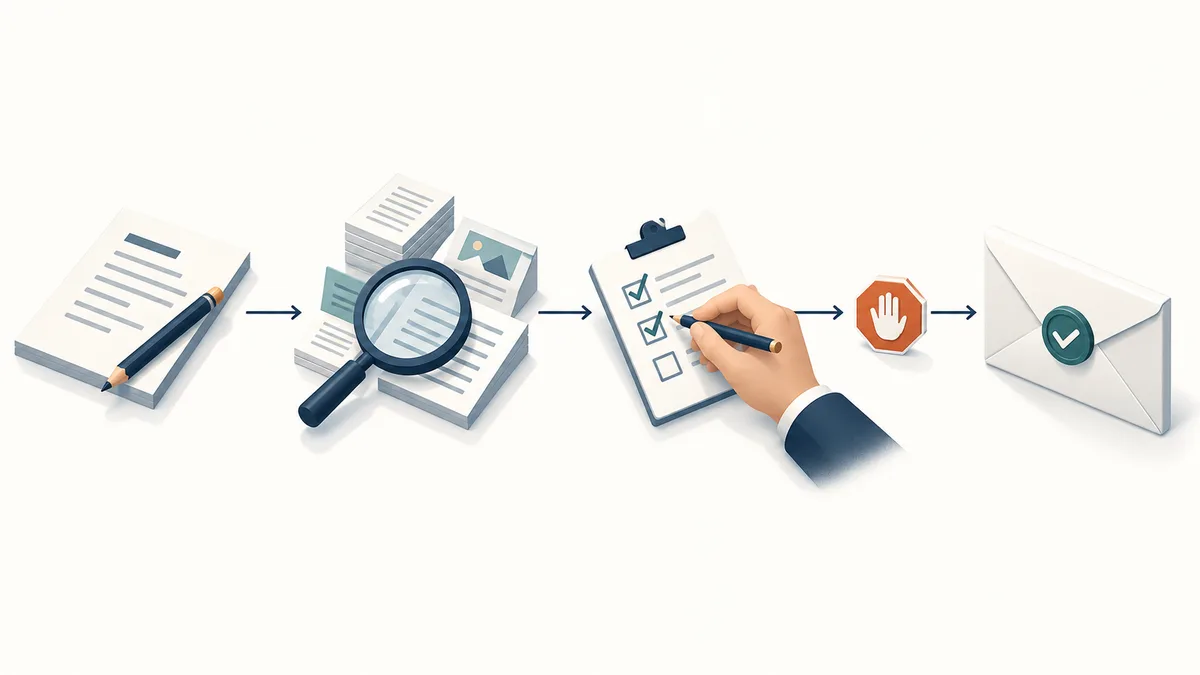
Compare the supplied workshop options against the brief. Separate confirmed facts, assumptions and unanswered questions. Put the source section beside each important claim. Flag conflicting dates or exclusions. Draft a short recommendation for my review. Do not contact suppliers, reserve a venue or make a payment.
The brief identifies the result, the evidence and the stopping point. The method in writing a prompt that works first try helps make those requirements explicit. If a quote says equipment is optional, the model should preserve that qualification. It should not quietly turn it into an included service to complete a neat comparison.
Now introduce a change: the workshop needs step-free access, or the date moves. Ask which earlier conclusions must change and which remain valid. Inspect whether the revision updates the actual recommendation, rather than adding a new paragraph while leaving an unsuitable supplier at the top. This tests how the workflow handles correction, not just how well the first answer reads.
- Check each decisive claim against its source, including dates, exclusions and conditions.
- Look for missing facts presented as settled facts, and conflicting evidence that disappeared from the draft.
- Confirm that the revised requirements changed the recommendation where necessary.
- Record the effort needed to review and repair the output, alongside any measured usage cost.
- Decide whether the result is ready for a human decision or needs another draft.
You do not need specialist knowledge to verify that a quote excludes catering or that a source never mentions accessibility. Start with these checkable details. Checking an AI answer when you are not the expert explains how to challenge a plausible answer without pretending to know the whole subject.
Capability does not decide permission
Google’s AI control explanation treats security as a system problem, including monitoring and controls that can prevent or stop actions. That is a useful distinction when planning a trial: the model’s ability to suggest an action does not settle whether the surrounding product should execute it.
For the workshop brief, keep drafting separate from contacting suppliers. If you later want messages sent, name the recipients and approve the content. Review the actual account connections and controls in the product you use. Do not infer them from an Argon benchmark, or assume that a rule you wrote in a prompt replaces an application’s permissions.
What to do next
Check official availability, save a bounded trial brief and define what would count as a useful result. When access arrives, record the model and product you actually used, then judge evidence, corrections and review effort. For routine drafting, keep using a tool that already meets your needs; a new model announcement is a reason to evaluate, not an obligation to switch.
Coursium teaches practical AI skills on your phone. Its approach to learning is relevant to the durable part of this work: setting a clear task and checking the result. Coursium does not provide Argon access. The useful preparation is a brief you can reuse and a review process that still works when the next model name arrives.
Frequently asked questions
Is Gemini 4 Argon available to everyone?
As of 1 October 2026, Google describes initial Gemini 4 Argon access for selected trusted cyber defenders. Broader release is upcoming, starting with paid API customers and Google AI Ultra subscribers; Google’s announcement gives no calendar date.
How much will the Gemini 4 Argon API cost?
Google announced introductory US$2 per million input tokens and US$10 per million output tokens, rising to US$4 and US$20 after the introductory period. These are announced API rates, not a Gemini app subscription price.
Does Gemini 4 Argon’s million-token limit describe uploads?
Google’s launch announcement specifies a one-million-token output limit. Input context, uploads and interface limits must be checked separately in the documentation for the product or API used.